Transform Your Yard: Discover Stump Grinding Benefits
Why Professional Stump Grinding is Essential for Your Yard: Benefits, Safety, and Value
Stump grinding is the mechanical process of reducing a tree stump to wood chips by using a specialized grinder that severs the visible stump and the upper root collar, returning that material to the landscape. Homeowners gain immediate benefits from grinding: improved yard aesthetics, safer grounds for children and equipment, reclaimed usable space, and a lower risk of pest and disease spread from decaying wood. Many yards and landscapes suffer lingering hazards and visual clutter when stumps remain, so this article explains why professional stump grinding is often the most efficient, safe, and value-preserving option. You will learn the primary homeowner benefits, how professional services reduce risk compared with DIY approaches, the practical differences between grinding and full removal, and the ecological and safety dangers of leaving stumps untreated. Throughout, the article integrates practical guidance, EAV comparisons, and targeted checklists so you can decide when to schedule stump grinding and what to expect during a professional job.
Why Professional Stump Grinding Boosts Yard Safety, Value & Aesthetics
Professional stump grinding restores the landscape by removing the visible stump and grinding the root collar, which eliminates tripping hazards and creates immediate planting or hardscape opportunities. This process improves curb appeal and helps protect lawn equipment while reducing habitats for wood-destroying pests, delivering both aesthetic and safety outcomes. Below is a concise list of the most common homeowner-facing benefits and what each delivers for your yard. The list that follows highlights primary advantages that homeowners notice most after professional grinding.
Stump grinding delivers several practical homeowner benefits:
- Enhanced curb appeal: Removing stumps creates a clean, level surface that improves overall yard appearance.
- Safer outdoor space: Grinding eliminates tripping points and prevents mower and equipment damage.
- Pest and disease reduction: Removing decaying wood reduces habitat for termites and fungal spread.
These benefits often work together to make yards safer and more usable, leading to simpler landscaping and lower maintenance. For local homeowners seeking a quote and expert guidance, Volusia Bobcat & Tree Service offers free onsite quotes and localized arborist knowledge, which can help determine the most appropriate grinding plan before work begins.
Different stump grinding benefits operate through distinct mechanisms and produce measurable outcomes, summarized in the table below.
| Benefit | How It Works | Expected Outcome |
|---|---|---|
| Aesthetic improvement | Grind and level stump to soil grade | Cleaner landscape and easier planting |
| Safety hazard mitigation | Remove protruding wood and root collars | Reduced trips and equipment damage |
| Pest prevention | Eliminate decaying wood habitat | Lower risk of termites and carpenter ants |
This table clarifies how each benefit maps to a homeowner outcome and helps prioritize work based on yard goals and safety concerns. The next section explores how stump grinding specifically enhances property value and visual continuity across a landscape.
How Does Stump Grinding Enhance Yard Aesthetics and Property Value?
Stump grinding enhances visual continuity by removing irregular wood shapes and returning the area to a level surface that allows for sod, planting beds, or hardscaping installation.
The mechanism is straightforward: removing the visible stump eliminates a focal eyesore and opens space for higher-value landscape features, which can contribute to perceived property value increases when potential buyers evaluate curb appeal. An example scenario: reclaiming a former stump location for a patio or flowerbed often provides immediate functional value that landscaping professionals cite as a common homeowner upgrade. Recent studies and market observations indicate that tidy, hazard-free yards influence buyer impressions, and a smooth, maintained lawn reduces perceived deferred maintenance. Understanding these visual and practical changes leads directly to the next topic: how grinding also reduces tangible hazards that affect daily safety.
In What Ways Does Stump Grinding Improve Safety by Eliminating Hazards?

Grinding removes protruding wood and the upper root flare that cause trips, falls, and mower strikes, directly lowering accident risk for children, pets, and visitors. The mechanical action reduces sharp edges and hidden roots that can snag equipment, so homeowners avoid costly lawn-mower repairs and personal injury incidents. For liability-conscious property owners, removing a visible hazard is a clear preventive measure that demonstrates reasonable care in landscape maintenance. After addressing how grinding improves safety, it is important to compare the professional approach with DIY methods to understand why hiring skilled operators matters for both results and risk management.
Why Is Professional Stump Grinding Safer and More Effective Than DIY Methods?
Yes — professional stump grinding is generally safer and more effective than DIY methods for several reasons: trained operators handle powerful grinders that cut efficiently, professionals follow safety protocols that reduce injury risk, and companies carry insurance and guarantees that protect homeowners.
Many DIY attempts fail or increase risk due to lack of training and proper equipment. Common mistakes include underestimating grinder power requirements, inadequate PPE, and ineffective handling of underground utilities.
The bullet list below highlights key DIY hazards homeowners should consider before attempting their own stump work.
- Injury from improper equipment use: Unfamiliar operators risk lacerations and crush injuries.
- Utility strikes: Inadequate locating can sever buried lines or irrigation systems.
- Incomplete grinding: Shallow grinding leaves root collars that encourage sucker growth and regrowth.
These risks underscore why many homeowners prefer professional services; the next subsection explains how a local provider applies procedural safeguards to manage these concerns.
What Risks Are Associated with DIY Stump Grinding?
DIY stump grinding commonly exposes homeowners to sharp rotating cutting teeth, thrown debris, and unpredictable root resistance, increasing the likelihood of lacerations, eye injuries, and equipment damage. Without professional-level personal protective equipment and training, operators may not anticipate wood kickback or the machine’s torque, which can cause loss of control and serious accidents. Additionally, many DIYers fail to properly identify and mark underground utilities or irrigation lines, creating a significant hazard during grinding. Recognizing these common failure modes clarifies why hiring a licensed and insured provider often reduces both personal risk and potential property damage.
How Does Volusia Bobcat & Tree Service Ensure Expert and Safe Stump Grinding?
Volusia Bobcat & Tree Service uses its local tree-service expertise to manage stump grinding with structured safety measures and client protections, including free onsite quotes, licensed and insured crews, public liability insurance, and a safety guarantee. Their experienced operators assess site conditions during the quote, advise on depth and disposal options, and can respond with emergency tree services when storm damage creates urgent hazards—services available 24/7. These business-level safeguards reduce homeowner liability and ensure work conforms to safety expectations without requiring homeowners to manage complex procedures themselves. With safety and certification in place, homeowners can focus on post-grind landscaping options that reclaim usable yard space.
What Are the Differences Between Stump Grinding and Stump Removal?
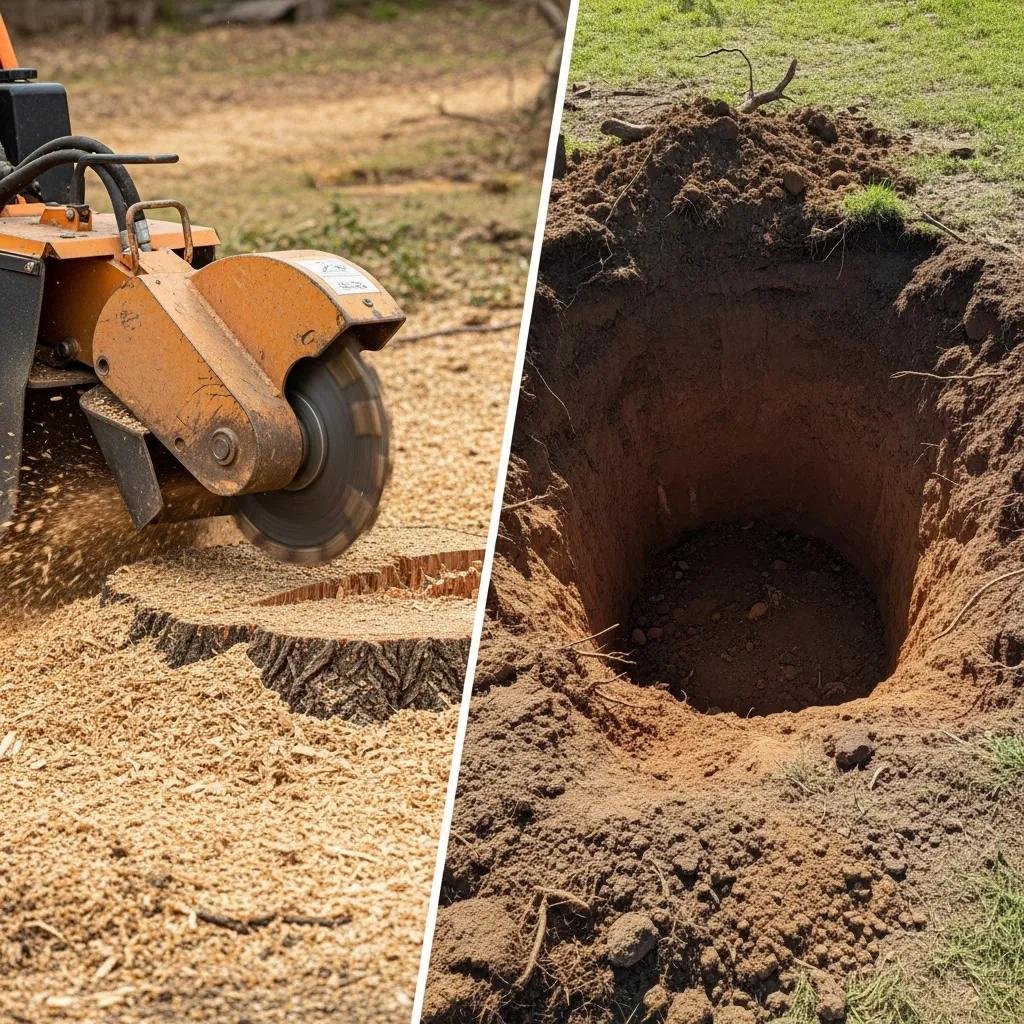
Stump grinding and stump removal are distinct approaches: grinding reduces the stump to wood chips and leaves most roots in place, while full stump removal extracts the stump and root mass, often leaving a larger hole and greater soil disturbance. Grinding is typically less invasive, faster, and more cost-effective, whereas removal provides a more complete root extraction required for heavy construction or septic and foundation work.
The compact comparison table below contrasts key attributes so homeowners can decide which approach aligns with their future plans and constraints.
| Approach | Characteristic | Ideal Scenario |
|---|---|---|
| Stump grinding | Less invasive; preserves most roots | Landscaping, safety clearance, quick reclaiming |
| Stump removal | Removes root mass; highly disruptive | Construction, foundation work, septic installation |
| Root excavation (deep) | Targeted root elimination; high disturbance | Structural root interference near utilities |
This comparison shows grinding is usually appropriate for aesthetic and safety needs, while removal suits structural projects requiring complete root extraction. Next, practical guidance helps homeowners choose between grinding and removal based on their specific goals.
When Should You Choose Stump Grinding Over Full Stump Removal?
Choose stump grinding when the primary goals are to remove hazards, improve appearance, or prepare an area for planting or light landscaping, because grinding is quicker and causes less soil disruption. If future plans include patios, lawn restoration, or planting beds in the same spot, grinding allows for easier backfilling and faster reestablishment of turf or plantings. Conversely, opt for full removal if deep root systems threaten foundations, driveways, or septic systems—situations where residual roots must be eliminated. Considering accessibility, number of stumps, and desired final grade helps homeowners decide whether the minimal disturbance of grinding or the thoroughness of removal best meets their needs.
How Do Costs Compare Between Stump Grinding and Removal Services?
Costs vary by stump diameter, accessibility, species, and number of stumps, and grinding typically costs less than full removal because it requires less labor and soil handling. Smaller, accessible stumps are usually the most affordable to grind, whereas large stumps near structures or in confined spaces can increase price for either approach. When evaluating cost-effectiveness, homeowners should consider the intended use of the area: grinding often delivers the best return for landscaping and safety goals, while removal is an investment when construction or deep root eradication is required. Understanding these cost drivers helps homeowners set realistic budgets and expectations before scheduling work.
What Are the Dangers of Leaving Tree Stumps Untreated in Your Yard?
An untreated tree stump is a persistent problem: it provides habitat for wood-destroying insects, can harbor fungal pathogens, creates tripping hazards, and can produce unwanted sucker growth that degrades landscape plans.
Over time, decaying stumps contribute to soil-borne disease vectors and attract pests that may spread to healthy trees and nearby structures.
The bullet list below outlines the most common dangers associated with leaving stumps in place and highlights why prompt action—monitoring or grinding—reduces long-term risk.
- Pest infestation: Stumps attract termites and carpenter ants that may migrate to structures.
- Disease spread: Fungal pathogens in decaying wood can infect nearby trees and shrubs.
- Physical hazards: Exposed stumps create trips and damage to lawn equipment.
Recognizing these dangers clarifies why grinding is often recommended as a preemptive measure to protect both landscape health and household safety.
How Do Tree Stumps Attract Pests Like Termites and Carpenter Ants?
Decaying wood in a stump provides moisture, shelter, and a food source that draws wood-destroying insects such as termites and carpenter ants, enabling colonies to establish and expand. Common signs of infestation include sawdust-like frass, mud tubes near stumps, visible galleries in softened wood, and increased insect activity in surrounding mulch or structural timbers. Prompt grinding removes the core habitat and breaks up continuity of decaying wood, which reduces the likelihood that pests will spread into adjacent structures or healthy trees. Monitoring for these signs and acting quickly to eliminate the stump habitat helps maintain a pest-resilient yard.
What Safety and Environmental Hazards Do Untreated Stumps Pose?
Untreated stumps pose several hazards: they are trip and fall hazards that can cause injury, interfere with mowing and landscaping equipment, and serve as reservoirs for fungal diseases that spread via root contact to nearby trees. Additionally, many stumps produce sucker sprouts that disrupt planned plantings and require repeated maintenance to control. Environmentally, decaying stumps alter soil nutrient cycles and can concentrate pathogens in one location, which compromises soil health near desirable plants.
For these reasons, grinding or monitored removal is a practical mitigation strategy to protect both yard usability and landscape ecology.
For homeowners ready to assess stump needs and schedule professional grinding, Volusia Bobcat & Tree Service provides free onsite quotes and local expertise, plus licensed, insured crews and a safety guarantee to ensure work is completed responsibly and with minimal disruption. Requesting a quote gives you a clear plan and helps prioritize which stumps to address first based on safety, pest risk, and landscaping goals.